
How Much Is Manual Work Really Costing You? A Practical Automation Audit
Every business has tasks that feel too small to worry about. Someone copies data from an email into a spreadsheet. Someone else chases a manager for an approval. A third person rebuilds the same weekly report by hand. Individually, these jobs look harmless. Together, they form a hidden tax on your growth. Manual work costs far more than the hours it takes, and most leaders only see a fraction of the bill. The first layer is direct labor. Consider a team of ten people who each spend five hours a week on repetitive admin. At an average loaded cost of $25 per hour, that is roughly $65,000 a year spent on work that software could handle in seconds. The second layer is error. Manual data entry invites typos, duplicate records, missed follow-ups, and billing mistakes, and each one creates rework, refunds, or unhappy customers. The third layer is delay. When approvals, invoices, and handovers depend on people remembering to act, your processes move at the speed of your slowest inbox. The fourth layer is opportunity cost. Skilled employees who spend their days on copy-and-paste tasks are not selling, designing, or serving customers. Businesses in the United States, United Kingdom, Canada, Australia, Singapore, Japan, and across Europe all face the same pressure: rising wages, tighter margins, and customers who expect instant answers. Competitors that automate workflows can respond faster, scale without hiring at the same pace, and make decisions from live data instead of last month’s spreadsheet. Understanding what manual work truly costs is the first step toward fixing it. Before you invest in any technology, you need a clear picture of where time, money, and goodwill are leaking out of your operations today. That is exactly what a practical automation audit delivers, and it is simpler than it sounds.
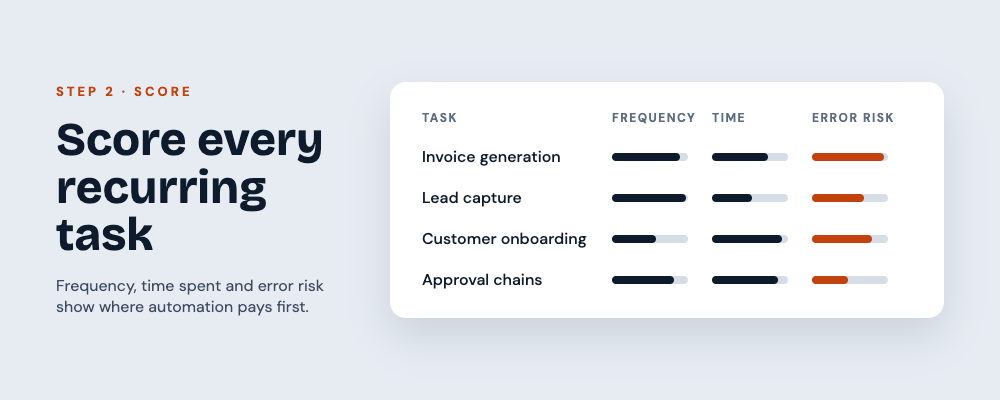 A practical automation audit does not require consultants or complex software. It needs a few honest conversations and a simple spreadsheet. Start by listing every recurring task in your business, department by department. Ask each team member to note what they do daily or weekly, how long it takes, and how often mistakes happen. Next, score each task on three measures: frequency, time spent, and error risk. Tasks that happen often, take long, and break easily are your best automation candidates. Typical examples include invoice generation, lead capture, customer onboarding, inventory updates, staff attendance, field reports, and approval chains. Then calculate the real cost. Multiply the hours spent by your loaded hourly rate, add the cost of errors and delays, and total it for the year. Many leaders are surprised when a single process, such as manual quotation handling, turns out to cost more annually than a custom tool would cost to build. After that, map each process as it works today. Write down every step, every handover, and every system involved. You will quickly spot duplicate data entry, unnecessary approvals, and information trapped in email threads. Finally, rank your list by impact and effort. Choose one or two quick wins that deliver visible savings within weeks, rather than trying to automate everything at once. This focused approach lowers risk, builds team confidence, and gives you clear numbers to justify further investment. It also helps you decide what should stay human. Customer relationships, creative decisions, and complex judgment calls deserve people. Repetitive, rule-based work does not. Document your findings in a short report with current cost, expected savings, and priority order. Keep it short, clear, and shareable with your leadership team. That report becomes the blueprint for your automation roadmap, whether you build internally or work with a development partner.
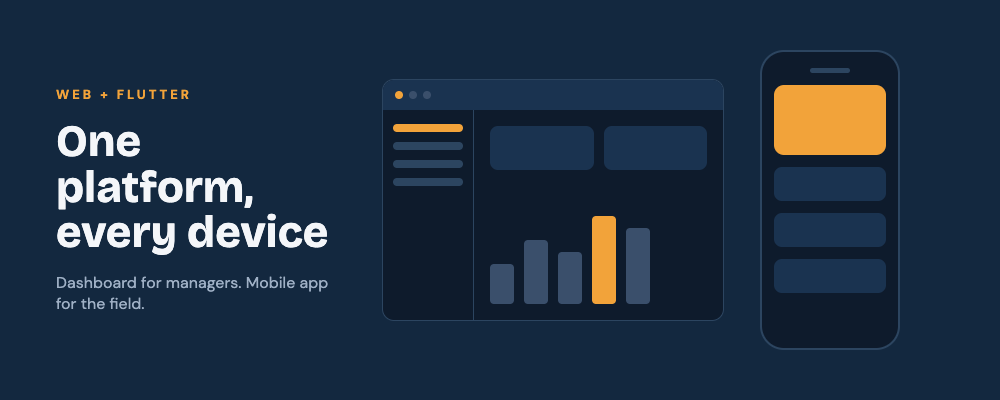 Once your audit reveals where manual work is draining value, the next question is how to fix it. Off-the-shelf tools can help with simple problems, but they often force your business to adapt to the software. Custom application development works the other way around. The software is built around your workflows, your rules, and your customers. A custom web application can act as the control center for your business. It can handle approvals, billing, reporting, user roles, and integrations with the accounting, CRM, and payment systems you already use. A cross-platform Flutter mobile app extends that power to your field staff, sales teams, and customers. Because Flutter uses a single codebase for both iOS and Android, you launch faster, spend less on maintenance, and deliver a consistent experience on every device. Together, a web dashboard and a Flutter app give managers real-time visibility while employees capture data on the go, with no re-typing and no paper trails. Security, scalability, and data privacy matter just as much as features, especially for companies operating under regulations such as GDPR in Europe, privacy laws in Japan and Singapore, or data protection rules in Canada, Australia, the UK, and the United States. A reliable development partner builds these requirements into the architecture from day one. At Aeonaxis Softech, we design and develop custom web and Flutter applications that turn audit findings into working automation. Our team supports clients across global markets with transparent communication, agile delivery, and long-term maintenance. Ready to find out what manual work is costing your business? Start with the audit, pick your first quick win, and talk to a partner who can build it. Small steps, taken early, compound quickly. Contact Aeonaxis today for a consultation and take the first step toward a faster, leaner, more automated business.




Leave a Reply