
Solar-Powered Containerized Data Centres in India: The Future of Sustainable Digital Infrastructure
Containerized Data Centres and the Solar Opportunity in India
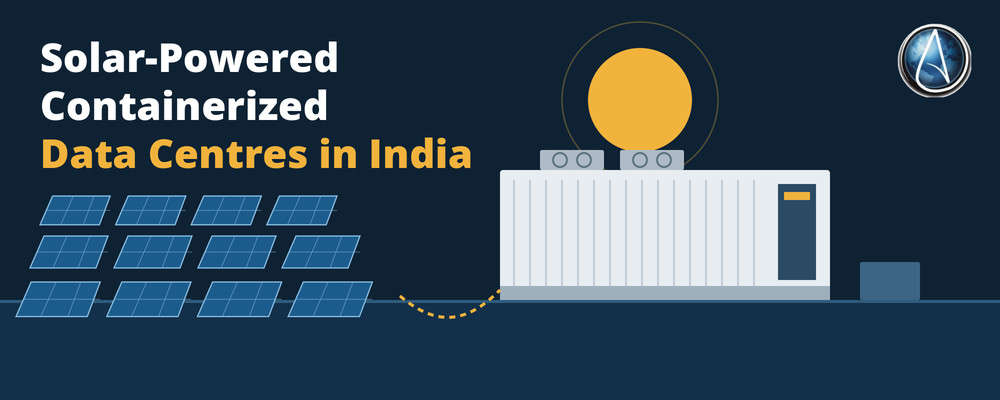
A containerized data centre is a complete, self-contained computing environment built inside a purpose-fitted steel enclosure, often shipping-container based. Racks, servers, networking, cooling, power distribution, fire detection and access control are installed and tested in a controlled setting, then transported to the site as a ready module. A mini data centre follows the same logic at smaller scale: a compact facility sized for a department, plant, campus or district rather than for thousands of racks. Unlike a traditional large data centre, which usually involves a purpose-built building, long construction schedules and heavy civil work, a modular data centre can be planned, delivered and expanded in stages. For India, this matters in many settings: industrial sites, remote locations, telecom facilities, public infrastructure, smart-city projects and distributed operations that need computing close to where data is generated. This is the core idea behind edge computing infrastructure, where local processing reduces dependence on distant facilities. Solar photovoltaic generation can be added to this picture. Panels on rooftops, land or canopies produce direct current, which inverters convert for use by the site’s electrical system and, where designed accordingly, the container’s power chain. Combined with grid supply and energy storage, solar can reduce the amount of electricity drawn from other sources during sunlight hours. The practical benefits of a solar-powered data centre include modular deployment, scalability by adding units as demand grows, space efficiency and potential energy-cost optimisation. None of these benefits is automatic. A sound project begins with a site-specific feasibility assessment covering available land or roof area, sunlight conditions, grid quality, expected IT load, cooling needs, ambient temperature, dust, monsoon exposure, access, permissions and maintenance. Organisations exploring solar-powered containerized data centres in India should therefore treat them as engineered infrastructure projects, not catalogue purchases, and should insist on realistic assumptions before committing budgets.
 Solar Power, Energy Storage and Reliable Operations
 Solar Power, Energy Storage and Reliable Operations
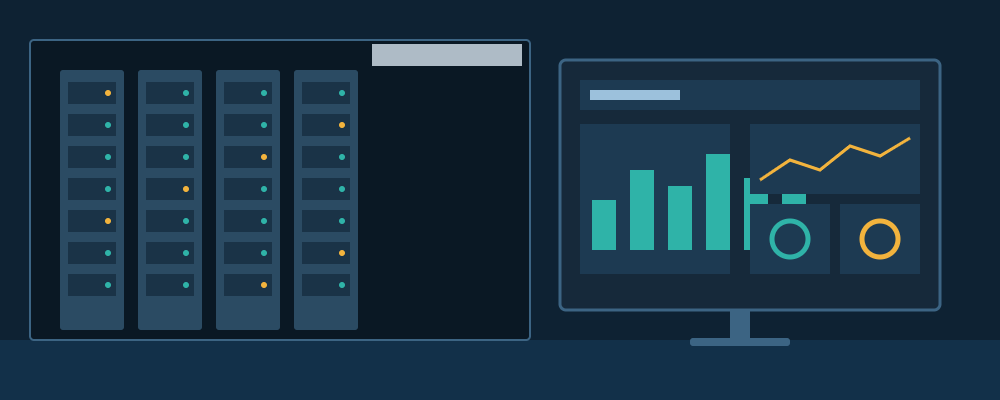
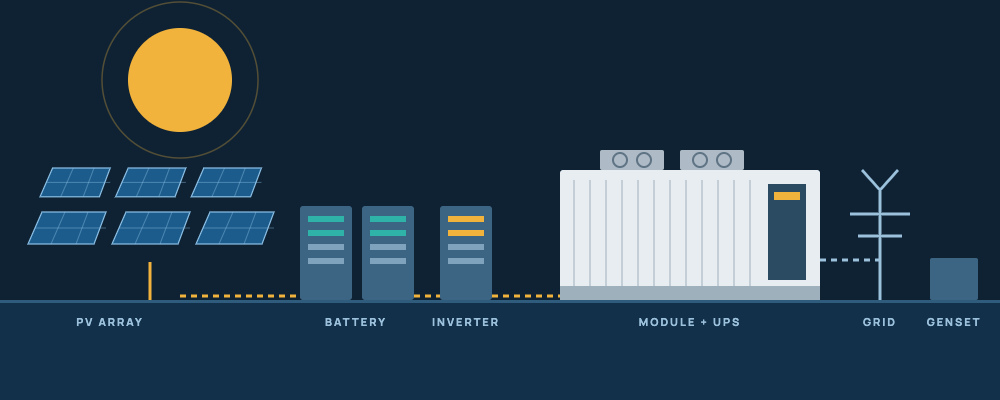
Reliable operation depends on how power sources are combined, not on solar panels alone. In a typical hybrid design, solar panels feed inverters, the utility grid supplies additional energy, battery energy storage smooths short interruptions and shifts some energy use, a UPS conditions power for the servers, and a backup generator covers longer outages. Each layer has a distinct job, and the interfaces between them need careful engineering. It is important to distinguish a grid-connected hybrid system from a genuinely off-grid installation. Hybrid systems use the grid as a continuous reference and fallback, which suits most business and government sites. Off-grid installations must carry the entire load alone, requiring far larger solar arrays, batteries and generators, and much more rigorous planning. Solar panels cannot guarantee uninterrupted 24/7 operation, because generation stops at night and drops during cloudy or monsoon periods. Design must also reflect the realities inside the container. Servers convert nearly all their electricity into heat, so cooling is often among the largest loads and strongly influences efficiency. Power distribution, environmental sensors, fire detection and suppression, and physical security each add requirements to the design. When evaluating a proposal, ask how long batteries can support the critical load, where redundancy exists, whether power quality meets equipment needs, how cooling performs in local summer temperatures, and how an energy-management system prioritises sources. Monitoring software and automation make these systems manageable. Data centre monitoring solutions can show generation, consumption, temperature, humidity, battery state and equipment status in one place. Alerts can notify operating teams about faults before they become outages, and maintenance records can support preventive servicing. Actual performance depends on location, load profile, weather, system sizing, operating conditions and the selected equipment, so any figures for savings or carbon reduction should come from a project-specific study, not from generic claims.
How Aeonaxis Can Help
 How Aeonaxis Can Help
Aeonaxis Softech is a Lucknow-based software development and system integration company, and it can support organisations that want to explore this kind of infrastructure. Its role is that of a technology and project-integration partner, not a manufacturer of every hardware component. Aeonaxis already offers mini data centre system integration, working with established OEMs to coordinate servers, networking, power, cooling and monitoring into a unified environment. For solar-powered projects, it can extend that approach by coordinating with qualified infrastructure and renewable-energy specialists for container enclosures, solar systems, batteries, UPS, cooling and fire-safety equipment. On the software side, Aeonaxis can build custom web applications and monitoring dashboards that bring energy, environmental and equipment data into one view, along with reporting interfaces for management and operations teams. Business automation and workflow integration can connect alerts to ticketing, maintenance schedules and approval processes, so that a fault leads to timely action rather than a forgotten notification. Aeonaxis can also help with IT infrastructure planning, project-specific technical planning, testing, deployment coordination and support, subject to the agreed scope. Clear documentation, defined responsibilities and a structured handover help customers operate the facility confidently after commissioning. The commercial value lies in having one accountable integration partner who understands both the digital side and the practical infrastructure around it, which can reduce coordination gaps between vendors. This is particularly relevant for government departments, infrastructure consultants, industrial enterprises, telecom operators and private organisations planning edge computing infrastructure or sustainable digital infrastructure. Every project begins with requirements: workload, location, power availability, growth plans and operating conditions. From there, a realistic architecture and scope can be developed with the right specialist partners. If your organisation is considering a solar-powered mini or containerized data centre, contact the Aeonaxis team to discuss your project and explore an approach that fits your operational needs.
Planning a Solar-Powered Mini or Containerized Data Centre?
Aeonaxis helps organisations explore integrated digital infrastructure solutions through software development, monitoring dashboards, workflow automation, and coordination with relevant infrastructure and renewable-energy partners. Contact our team to discuss your operational requirements and explore a project-specific approach to modular data-centre infrastructure.





Leave a Reply