
10 PRACTICAL WAYS AEONAXIS CAN HELP YOU AUTOMATE OPERATIONS
Business automation in 2026 is no longer limited to basic repetitive tasks. AI, workflow automation and connected business applications are increasingly being used to manage complete processes across departments. The key, however, is not to automate everything simply because technology makes it possible. Companies should identify processes where automation can deliver measurable improvements in speed, accuracy, cost and customer experience. Current research shows that organizations are increasingly moving from isolated AI experiments toward integrated, end-to-end workflows.
Below are 10 practical areas where businesses can start applying automation today:
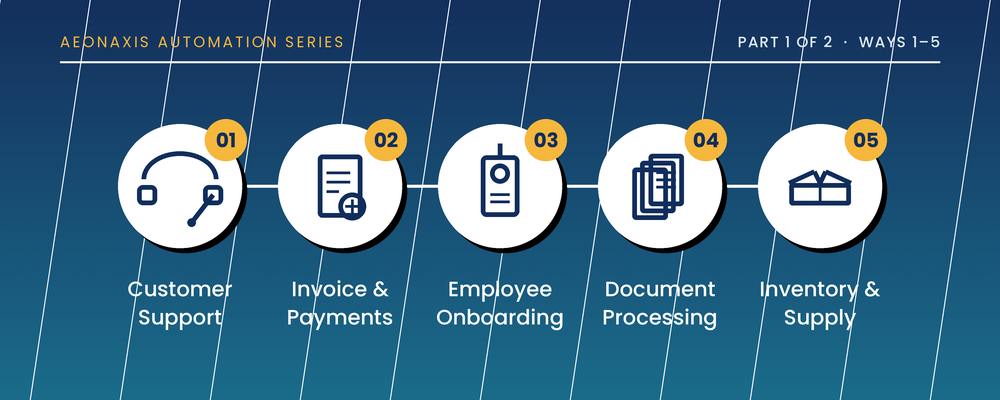
1. Automate Customer Support
- AI-powered chatbots can answer frequently asked questions 24/7.
- Customer enquiries can be automatically categorized and assigned.
- Order-status, appointment and basic troubleshooting requests can be handled without human intervention.
- Complex issues can automatically be escalated to the appropriate employee.
2. Automate Invoice & Payment Processing
- Extract information automatically from invoices and purchase orders.
- Match invoices with purchase orders and delivery records.
- Identify discrepancies before payment.
- Route invoices to the right person for approval.
- Reduce manual accounting and data-entry work.
 3. Automate Employee Onboarding
 3. Automate Employee Onboarding
- Automatically collect employee information and documentation.
- Generate employment-related documents.
- Create user accounts and access permissions.
- Assign training and onboarding tasks.
- Send automated reminders to HR, managers and new employees.
4. Automate Document & Data Processing
Businesses handling large volumes of PDFs, forms, emails and spreadsheets can use AI-powered document processing to extract, classify and transfer information automatically. This can significantly reduce repetitive data-entry work while improving consistency.
5. Automate Inventory & Supply Chain Operations
- Monitor stock levels in real time.
- Trigger replenishment when inventory reaches predefined thresholds.
- Generate purchase requests automatically.
- Track shipments and delivery status.
- Use historical data to improve demand forecasting.
This is particularly valuable for retailers, distributors and manufacturers where inventory decisions directly affect revenue and customer satisfaction.
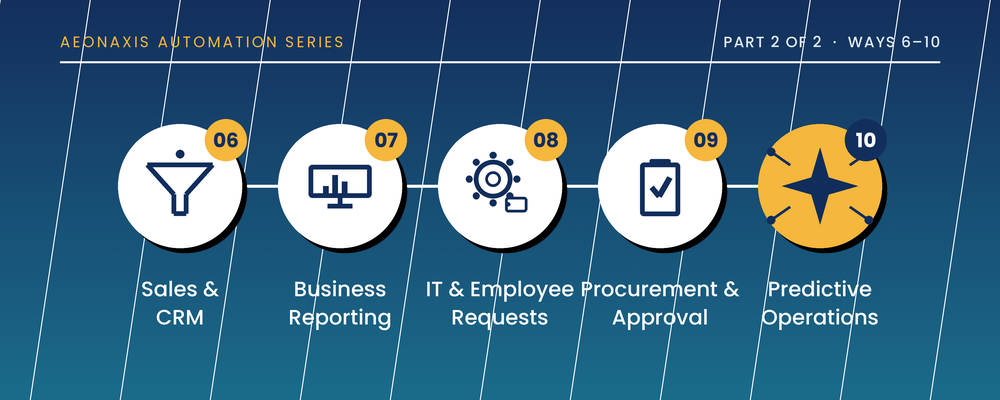
6. Automate Sales & CRM Activities
Sales teams spend significant time updating CRM systems, qualifying leads and following up with prospects. Automation can capture website enquiries, score leads, assign them to sales representatives, update customer records and trigger personalized follow-ups automatically.
7. Automate Business Reporting
 7. Automate Business Reporting
Instead of manually collecting information from multiple spreadsheets and systems, businesses can connect their CRM, ERP, accounting and operational platforms to automated dashboards.
Automated reporting can:
- Update management dashboards in real time.
- Generate scheduled reports.
- Track KPIs automatically.
- Alert managers when performance falls below predefined thresholds.
- Reduce dependency on manually prepared spreadsheets.
8. Automate Internal IT & Employee Requests
Routine IT and administrative requests are another strong automation opportunity. Employees can use an AI-powered internal assistant to request software access, reset passwords, locate company information, raise service tickets or receive answers to common workplace questions.
9. Automate Procurement & Approval Workflows
Companies can automate purchase requests, approval hierarchies, vendor documentation and procurement notifications. Instead of sending emails back and forth, a digital workflow can automatically determine who needs to approve a request, record the decision and move the transaction to the next stage.
10. Use AI for Predictive & Proactive Operations
The most advanced opportunity is moving from reactive operations to predictive operations. AI can analyze business data to identify patterns and potential problems before they become expensive issues.
Depending on the industry, this could include:
- Predicting equipment maintenance requirements.
- Forecasting customer demand.
- Detecting unusual transactions.
- Identifying potential delivery delays.
- Predicting inventory shortages.
- Highlighting operational risks.
AI agents are also increasingly capable of handling multi-step workflows rather than simply answering questions, making them particularly relevant for business process automation in 2026.





Leave a Reply