
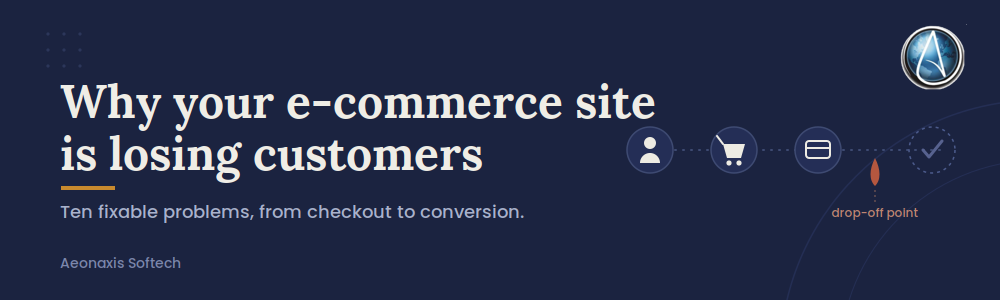
Why Your E-Commerce Website Is Losing Customers: 10 Problems You Need to Fix
An e-commerce website can have excellent products, competitive pricing and a strong marketing campaign, yet still lose customers before they complete a purchase. The problem is often not the product—it is the online experience. One of the biggest reasons customers leave an e-commerce website is slow loading speed. If pages take too long to load, visitors are likely to move to a competitor before even seeing the product. A second issue is a poor mobile experience. With a significant share of online shopping taking place through smartphones, a website that is difficult to navigate, has tiny buttons, requires excessive scrolling or displays incorrectly on mobile devices can quickly lose potential buyers. The third problem is complicated navigation. Customers should be able to find the product they want within a few clicks. Confusing categories, inadequate filters and poor site search can turn a simple purchase into a frustrating experience. The fourth issue is weak product presentation. Customers cannot physically examine products online, so high-quality images, detailed descriptions, specifications, size information, videos and customer reviews become essential. The fifth problem is a lack of trust. Missing contact information, unclear return policies, insecure-looking payment pages, limited reviews or an outdated website design can make customers hesitate before sharing their payment details. These issues may appear small individually, but together they can have a major impact on conversion rates. A professionally designed e-commerce website needs to do more than display products—it must remove friction at every stage of the customer’s journey. At Aeonaxis Softech (P) LTD, we approach e-commerce development with this principle in mind. Our team can design and develop responsive, user-friendly e-commerce platforms with intuitive navigation, optimized page structures, mobile-first experiences, effective product presentation and trust-building elements. Instead of simply creating a website that looks attractive, the objective is to build a digital storefront that makes it easier for visitors to discover products, understand their value and confidently move towards purchase.
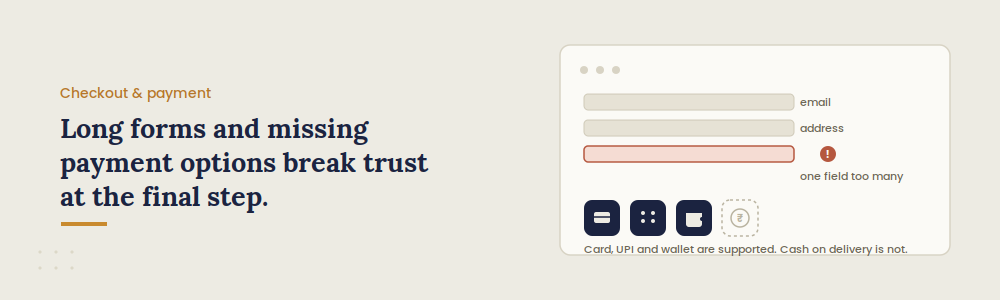 The problems don’t stop once a customer finds the right product. Checkout friction is another major reason e-commerce businesses lose otherwise interested buyers. Customers may abandon their carts when checkout forms are unnecessarily long, account creation is mandatory, payment options are limited or unexpected charges appear at the final step. This is the sixth problem: a complicated checkout process. The ideal experience should be simple, transparent and optimized for both desktop and mobile users. The seventh issue is limited payment flexibility. Depending on the target market, customers may expect UPI, cards, net banking, wallets, cash on delivery, EMI or other payment options. A website that does not support the payment methods customers prefer can lose sales unnecessarily. The eighth problem is poor order and inventory management. An attractive storefront cannot compensate for inaccurate stock information, delayed order processing, manual order tracking or disconnected systems. As order volumes increase, businesses need technology that connects the storefront with inventory, operations, customer management and logistics. This is where a basic website can quickly become inadequate. Aeonaxis can help businesses move beyond a simple online catalogue by developing e-commerce platforms with secure payment gateway integrations, shopping carts, streamlined checkout workflows, inventory management, order management, customer accounts, automated notifications and third-party API integrations. Where required, an e-commerce platform can also be integrated with existing ERP, CRM, accounting, warehouse or logistics systems, reducing repetitive manual work and improving operational visibility. We can also develop custom admin panels that allow business owners and teams to manage products, pricing, orders, customers, promotions, inventory and website content from a centralized interface. The objective is not to add features simply because they are available. Every feature should serve a business purpose—reducing operational effort, improving customer experience or helping the company sell more effectively. With a scalable architecture, businesses can start with the functionality they actually need and expand the platform as their product catalogue, customer base and operational requirements grow.
 Even after solving website performance, usability and checkout problems, there are two areas that many e-commerce businesses overlook: customer engagement and data. The ninth problem is treating every visitor in exactly the same way. Customers increasingly expect relevant product suggestions, intelligent search results, personalized offers and quick answers to their questions. A visitor looking for sports shoes, for example, should ideally be able to discover relevant products, sizes, related accessories and useful information without having to navigate through dozens of pages. AI can take this further through conversational shopping assistants, product recommendations, automated customer support, intelligent search and personalized experiences. The tenth problem is not understanding what customers are actually doing on the website. Without proper analytics, businesses may know their sales numbers but not understand where potential customers are dropping off, which products receive attention, which campaigns generate quality traffic or where the checkout process fails. Aeonaxis can help address both sides of this challenge by combining e-commerce development with AI, analytics, automation and digital technology solutions. We can build platforms that support product recommendations, AI-powered customer assistance, automated communication, lead and customer data management, analytics dashboards and integrations with marketing and business systems. This allows an e-commerce business to move from simply having an online store to building a more intelligent digital commerce ecosystem. Whether you are launching your first online store, migrating from an existing platform, upgrading an outdated website or building a completely custom e-commerce application, Aeonaxis can help with the complete technology journey—from UI/UX and website development to integrations, testing, deployment, maintenance and future enhancements. The right e-commerce website should not merely exist online; it should make buying easier for customers and managing the business easier for your team. If your website is attracting visitors but struggling to convert them, the answer may not be more advertising. It may be time to fix the technology and experience behind the sale.





Leave a Reply